Published

Brickanta
Most construction disputes are sitting in the bid package long before anyone calls a lawyer, written down and readable in a contradiction nobody caught or in a responsibility nobody assigned. By the time it surfaces on site the contract is signed, and there's little room left to act.
The most valuable legal work happens before construction starts, but only if the right questions get asked in time. Construction rarely makes that easy. The document set is large, the deadline is close, and the information is scattered across drawings, descriptions, provisions, and appendices. It's tempting to hand that pile to a general AI tool and move on. In construction, that quietly makes things worse.
The risk hides in the details
A bid package can run to hundreds or thousands of pages, and the risks are rarely labelled. They sit in the specifics.
A drawing states a 3m ceiling height while the building description says 2.7m. The priority rule has been quietly changed so the tender documents rank lowest, or removed from the contract entirely. A warranty period is stretched from five years to ten. Each looks minor on a first read. Once the project is underway, the same detail becomes a delay, a cost, or an uncaptured change order, extra work performed without a formal ÄTA order that turns into pure cost with no revenue attached.
Our report The Cost of Standing Still points the same way. Roughly SEK 164 billion in value is lost to weak productivity in Swedish construction every year, and most projects still run over budget and behind schedule. Much of that risk is set before the first spade hits the ground.
Why this needs agentic AI for construction, not another chatbot
Reading every document consistently, comparing them against each other, and surfacing what doesn't line up is exactly the work people rarely have time to finish by hand. A general chatbot won't close that gap. It has no view of construction law, no idea what the priority rule is, no control over the confidential bid data you paste in, and, most importantly, it hands back a plausible answer with no way to check where it came from. In construction, "this could be a risk" is worthless on its own. A lawyer can't assess it, an estimator can't price it, and a project manager can't take it to the client without knowing the source.
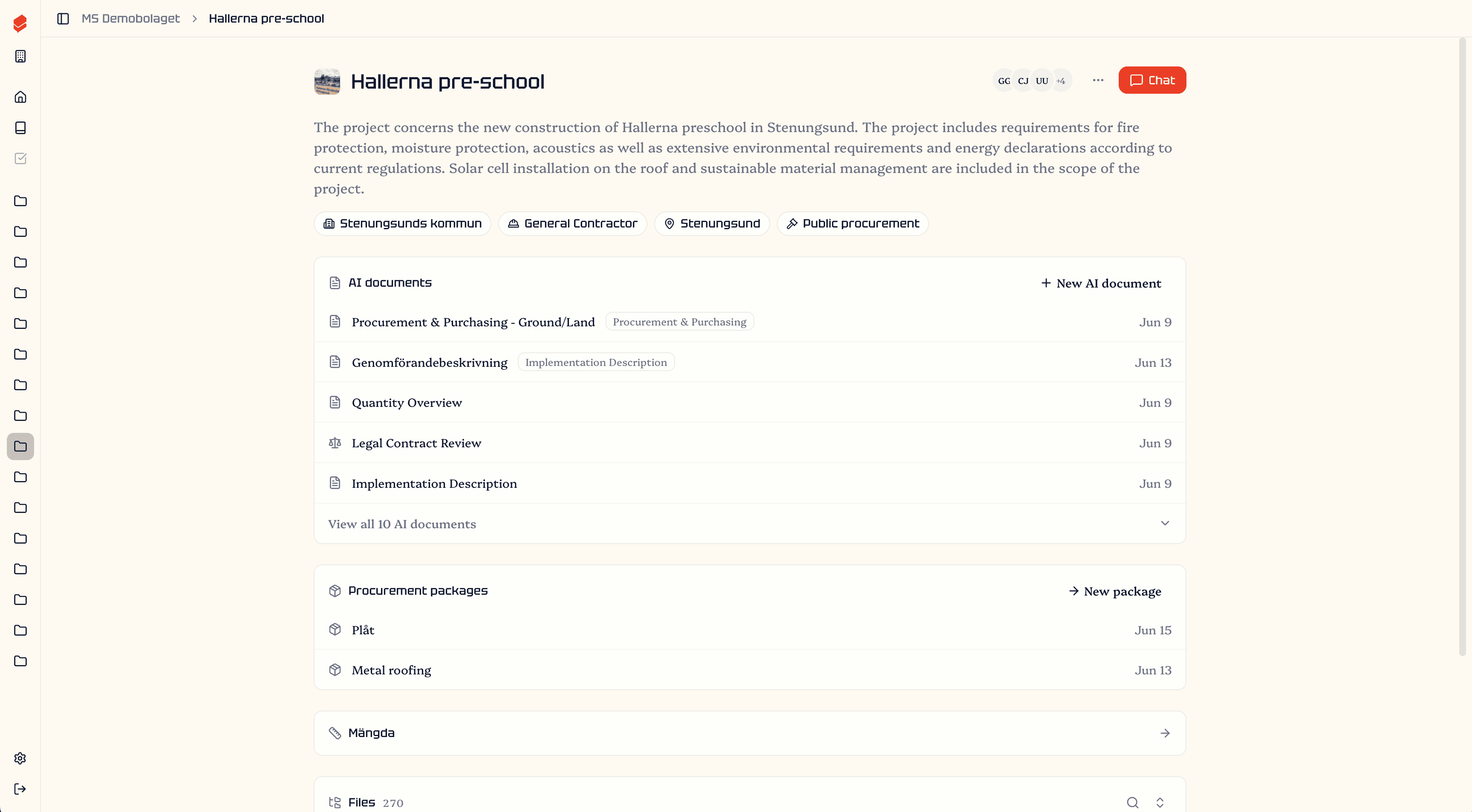
Brickanta's AI Documents is built for exactly this gap. It reads a full bid package and produces a structured review: contradictions between documents, deviations from the applicable contract framework, unclear responsibility boundaries, timelines and penalty exposure, and a lawyer-grade legal red-flag pass across scope, liability, and termination. Requirements are pulled into a single list, each one tied to the evidence that verifies it. Every finding traces back to its source, down to the document, page, and passage, so a flag is something you can act on rather than just something that only sounds alarming.
Legal risk starts in the documents. Risk analysis should start there too.
Request a demo of our Construction Law module.